
The first integration phase of four new WeldExp Modules calculators has already been completed. CIC, SFC, RSW and T85 now have dedicated module interfaces, basic input and persistence functions, and in several areas already include working calculation and risk-assessment foundations.
The next development phase is no longer about creating additional interface skeletons. Its goal is to complete, document and make the engineering calculation models verifiable. The modules must work from explicitly supplied or user-owned ClientDB data, while missing critical inputs must be reported clearly instead of being replaced by hidden estimates.
CIC – cast iron welding calculator
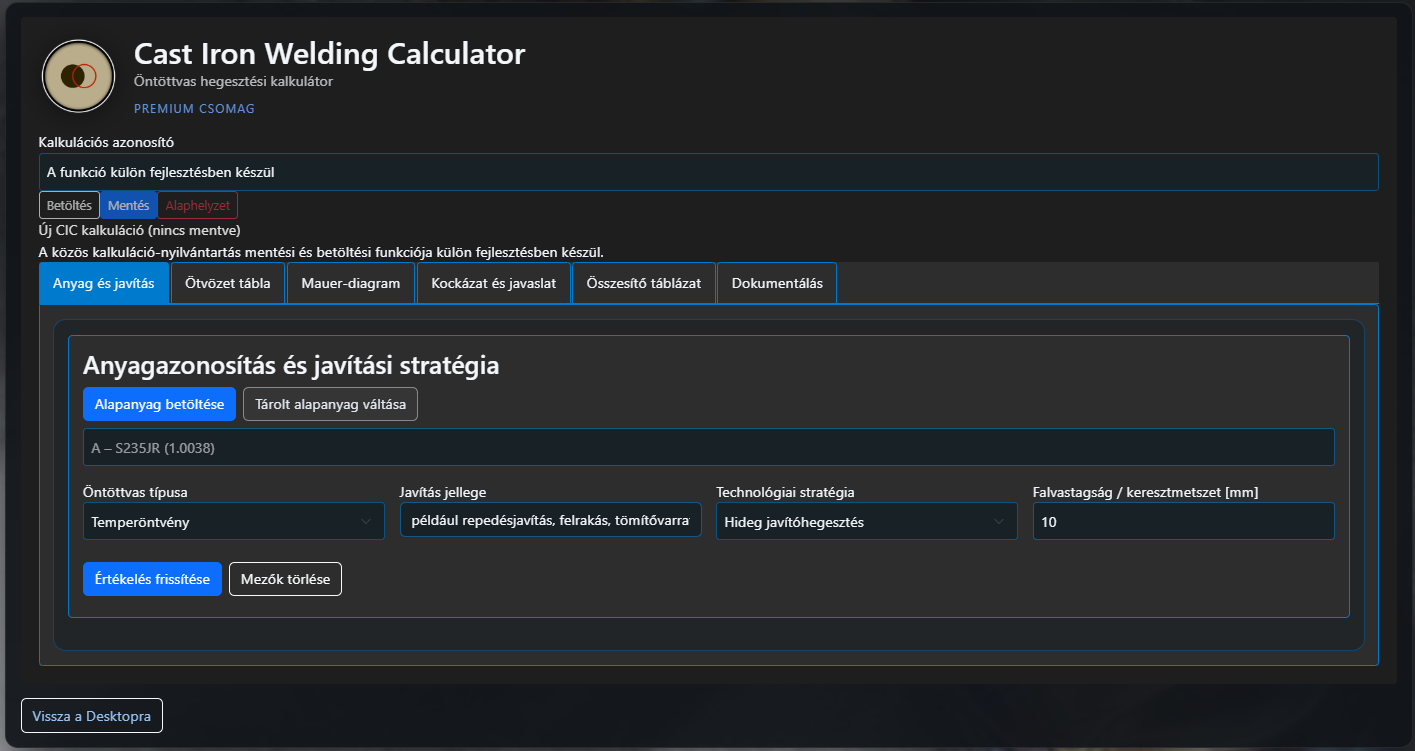
The cast iron welding module already supports manual or BML-assisted chemical composition input, a carbon-equivalent calculation basis, plotting the material point on the Mauer diagram and an initial risk assessment.
The main next steps are:
- true Mauer-diagram region logic: classification based on documented boundaries and regions rather than graphical proximity;
- graphitisation and white-iron risk: C–Si–P composition, cast-iron type and repair conditions evaluated together;
- repair strategy: wall thickness, repair type and the selected cold, moderately preheated or fully preheated approach must materially affect the recommendation;
- preheat, filler metal and cooling: recommendations based on a validated rule set, including Ni/NiFe-type filler metals, short weld runs and controlled cooling where appropriate;
- ClientDB integration: user-owned material data can be used directly in calculations.
SFC – sigma-phase risk calculator
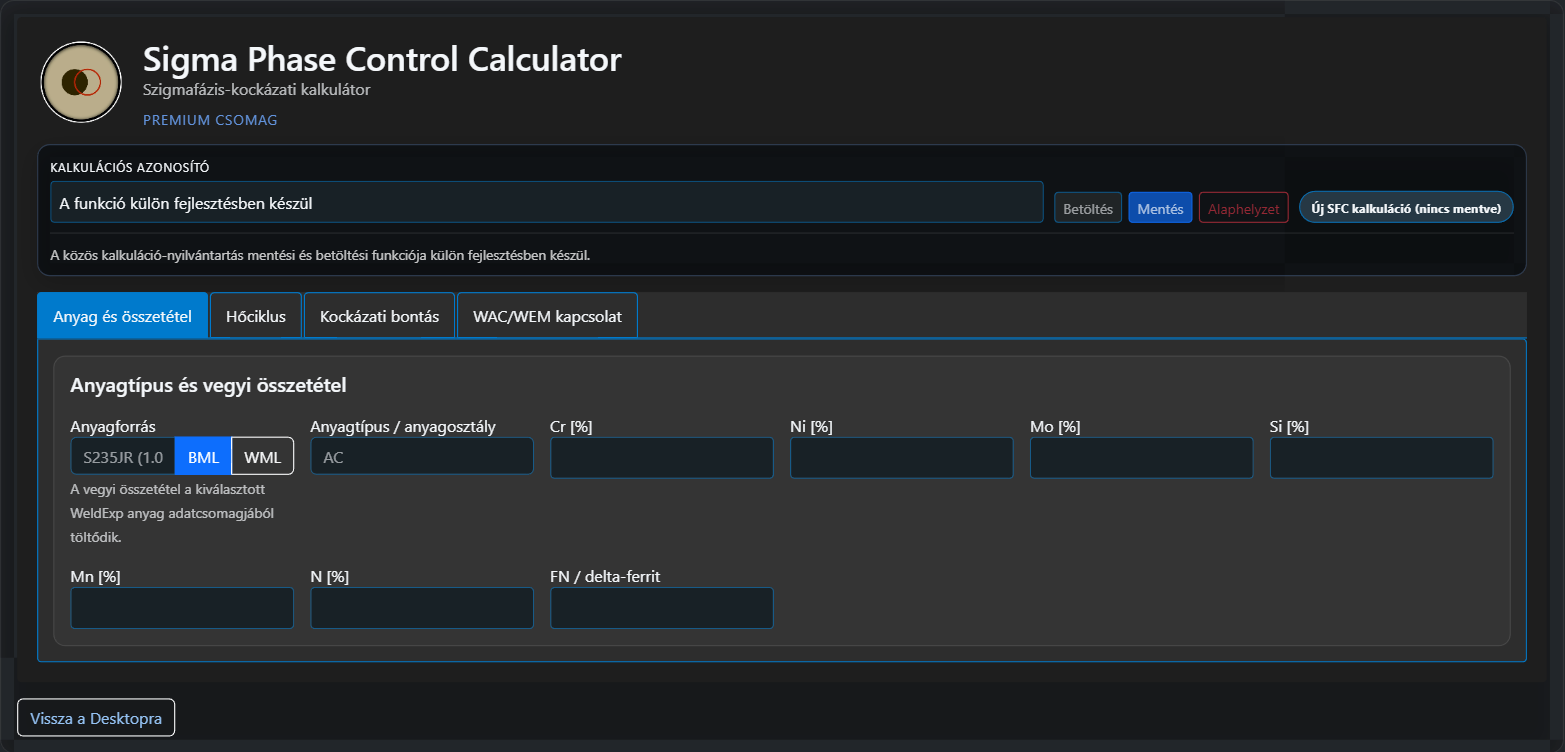
SFC evaluates the risk of sigma-phase formation in austenitic, duplex, superduplex, ferritic and heat-resistant Cr-Ni/Mo steels. The current base engine already considers factors such as Cr, Mo and Si content, heat input, interpass temperature, wall thickness, ferrite content, multipass welding and thermal exposure.
In the next phase:
- Ni, Mn and N content, together with material type, will become effective inputs to the engineering risk model;
- WAC/Bystram results will be transferable through a canonical, versioned data contract;
- the output will provide not only a risk level but also composition- and thermal-cycle-based reasoning;
- the decision rules and their validity ranges will be documented;
- technology guidance will cover changes to heat input, interpass temperature, cooling and, where technically justified, heat treatment.
RSW – resistance spot welding calculator
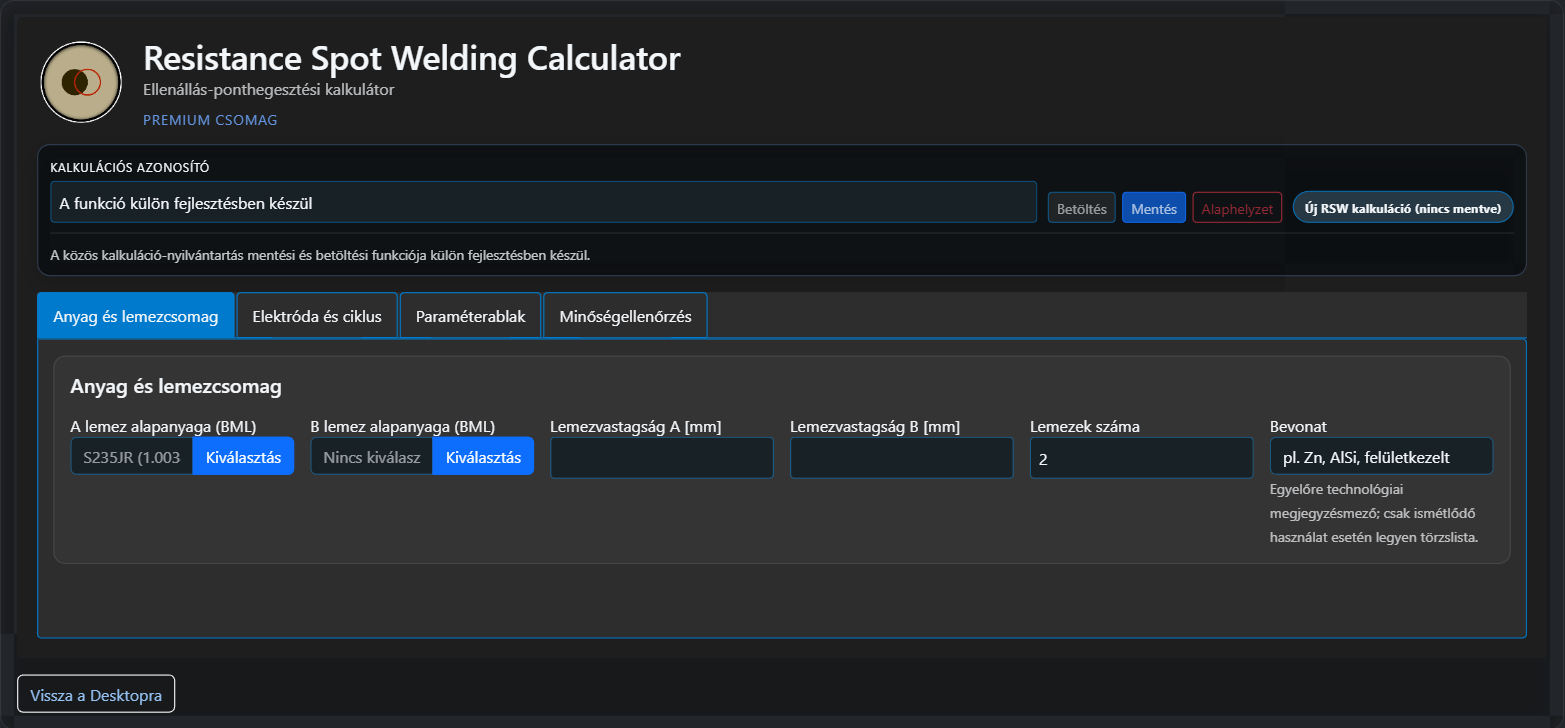
RSW already accepts welding current, weld time, electrode force, contact resistance and sheet thickness. It can calculate a comparative Q-type heat input, a simple target nugget size and basic risks for weak joints and expulsion/spatter.
The next stage will connect fields that are already stored but are not yet fully used by the calculation engine:
- two- or three-sheet stacks;
- coating and surface condition;
- electrode type and geometry;
- single- or multi-pulse welding profiles;
- squeeze and hold times;
- a recommended current–time–force process window;
- risk of electrode sticking, electrode wear and excessive heat input.
Later integration can also connect RSW to INV/INVL equipment records and measurement or test data.
T85 – t8/5 cooling-time planner
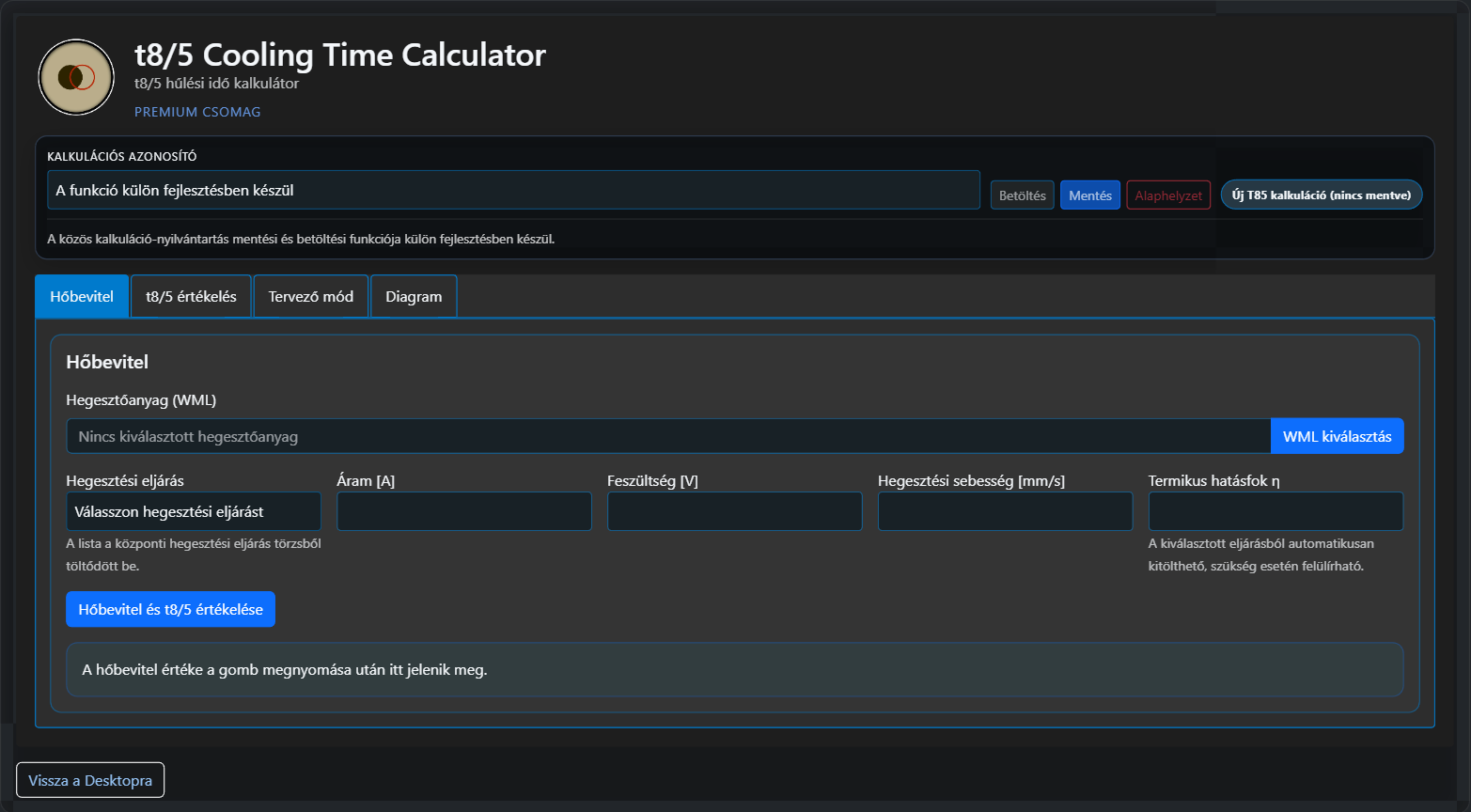
T85 supports welding thermal-cycle planning. Its purpose is to estimate how long the evaluated region takes to cool from 800 °C to 500 °C under the selected welding conditions and what hardening, cold-cracking or excessive-heat risks may follow.
The next development steps are:
- effective use of interpass temperature, the selected heat-flow model and target t8/5 value in the calculation;
- documented 2D, 3D and transitional heat-flow models with explicit validity conditions;
- a planning/reverse-calculation mode that derives suggested heat input, welding speed and preheat direction from a target t8/5 range;
- integration with the PRHTC preheat module and later with WPS/WPQR technology data;
- visible documentation of units, assumptions and engineering limits used by the model.
Common development direction
All four modules share the same requirements: calculations must use traceable data sources, engineering rules must be versionable, stored fields must actually participate in validation and calculation, and regression tests must cover the important calculation paths.
The roles of the central WeldExp database and the user ClientDB are also becoming more precise. Catalogue and reference links remain available, while actual calculation inputs should rely on user-supplied or ClientDB-stored engineering data. Another goal is to make calculation save/load workflows and later WPS/WPQR reuse more consistent.
The improvements will be introduced gradually in WeldExp Modules. The calculators remain engineering decision-support tools: their results and recommendations do not replace a qualified welding procedure, procedure qualification testing or the required engineering review.